
February is American Heart Month—a reminder to all that, yes, heart disease continues to be the leading cause of death in the United States! According to the Centers for Disease Control and Prevention , someone has a heart attack every 25 seconds in America, and someone will die from a heart attack every minute! Pretty frightening statistics, given that many risk factors for heart disease can be significantly reduced with modest lifestyle changes.

Although some risk factors—such as age and family history—can’t be controlled, most risk factors can! Making healthful food choices, being physically active, losing weight if overweight, and supplementing your diet with key nutrients that promote heart health are strategies you can implement to improve and protect the health of the most important organ in your body—your heart.

Start by looking to improve your food choices: Try to eliminate fast foods, which, in general, deliver unhealthy amounts of saturated and trans fats, along with excessive sugar and calories. Make a commitment to eat more fiber-rich whole grains and legumes. Look to include more fresh fruits and vegetables, plus a couple of servings per week of omega-3-rich fish such as salmon. Limit your intake of sweets and watch for higher sodium content of many processed foods.

Be more active! Physical activity not only helps lower blood pressure and cholesterol, it helps control your weight, reduces stress and anxiety, and improves blood circulation. If you’re among the two-thirds of Americans who are overweight, improving your diet and boosting your physical activity will help you lose those extra pounds—and also promote a healthy heart. Our Cinch Inch Loss Plan is a comprehensive weight management program that is clinically tested and helps to support metabolism.
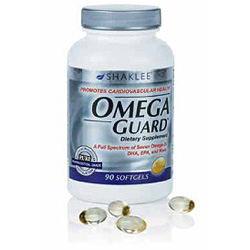
When it comes to heart-smart supplementation, Shaklee OmegaGuard is a great place to start! It provides a full spectrum of seven naturally occurring omega-3 fatty acids found in fish, including concentrated levels of DHA and EPA, the most beneficial omega-3s. OmegaGuard not only supports a healthy heart and cardiovascular system, it also supports healthy brain, vision, and joint function. And I’ve got more good news! We’ve taken the same great OmegaGuard formula and repackaged in two new sizes.
For people who are not using an omega-3 product, we are now offering a 60-count bottle with the recommendation of taking two softgels per day, which will deliver 667 mg of omega-3 fatty acids, or the equivalent of the American Heart Association’s recommendation for people who do not have heart disease. This will provide a lower-priced entry point for new consumers, in particular. Also, this is a perfect amount to add to Vitalizer as the combination of OmegaGuard+ Vitalizer will deliver over the 1000 mg of omega-3 fatty acids that my Health Science team and I recommend.
For additional heart-health support, don’t forget about our Cholesterol Reduction Complex and
CoQHeart. Cholesterol Reduction Complex features a blend of plant sterols and stanols to
help naturally lower cholesterol levels. CoQHeart features coenzyme Q10, a key nutrient
for cellular energy production, antioxidant protection, and healthy heart-muscle function.
Combined with OmegaGuard, you have a power trio of products to address heart health from
several different fronts!
I hope that this is a great motivator to take care of your and your families hearts!!!!
Happy Heath Health Month! :)
What do you do to take care of your heart?
This information was from Dr. Jamie McManus, M.D. :)
Come back tomorrow to read how I organize my cleaning schedule and get ready to link up your cleaning schedule!!!


